




No products in the basket.


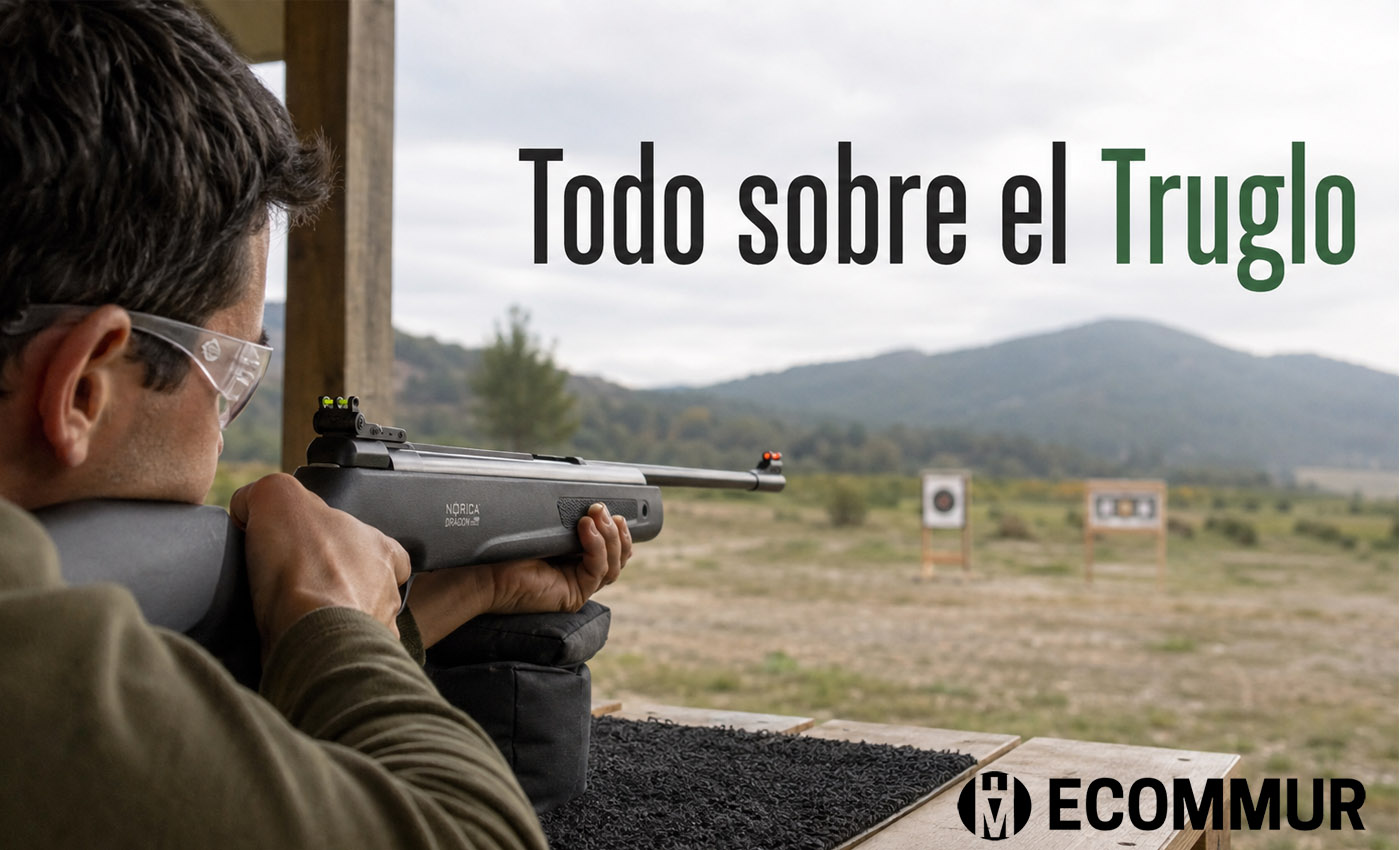
All About Truglo Leave a comment
On airguns, the term Truglo is often used for open sights with fibre optics, although one point is worth clarifying: TRUGLO is a brand, but many users also use the name to refer to this type of bright or high-visibility sight. In this guide, we explain it in practical terms, focusing on air rifles, CO2 pistols and recreational airguns.
What exactly is a Truglo sight?
A Truglo-type sight is an open sight that uses a small fibre-optic rod to collect ambient light and make the sighting point appear brighter. It is not a torch, it does not project light towards the target, and it does not work like a laser. Its purpose is much simpler: to help you see the aiming reference more clearly.
On an air rifle with traditional open sights, the rear sight and front sight are usually black or metallic. That can work well, but sometimes they are difficult to align quickly, especially against a dark background, in shadows, or for users with little experience. With fibre optics, the front sight and, in many cases, the rear sight dots are easier to see thanks to the increased contrast.
How fibre optics work in a sight
The fibre optic collects some of the surrounding light and visually concentrates it at the end of the rod. That is why, when you look through the sights from behind, you see a brighter coloured dot. The more ambient light there is, the more noticeable the dot usually appears. “` Outdoors, in natural light, these sights tend to stand out very clearly. They can also help in well-lit indoor areas. However, if you are in a very dark place, a standard fibre optic does not “glow on its own” like a tritium system or an illuminated electronic sight. | Key idea It needs ambient lightFibre optics improve the visibility of the sighting point, but they do not turn the sight into night vision. If there is not enough light, it will be less visible. |
Why the difference is so noticeable when aiming
The human eye detects coloured points and contrasts very quickly. For this reason, a fibre-optic sight can make sight acquisition feel more natural, especially for users who do not want to fit a scope or who prefer a light and simple air rifle.
Faster
You find the sighting point sooner
The front sight stands out more than a traditional black sight. This helps when you raise the gun and need to align the sights quickly.
More comfortable
Less visual effort
The increased contrast makes it easier to focus on the correct point, especially during long recreational shooting sessions.
Simpler
No battery required
A standard fibre-optic sight does not need to be switched on, charged or configured. It is always there and works as long as there is enough light.
Truglo improves the aiming reference, but it does not replace technique
This is the part that many product descriptions do not explain: a Truglo sight can make aiming more comfortable, but accuracy still depends on the gun, ammunition, distance, shooting position, trigger control and shot consistency. It is a genuine aid, but not a magic solution.
Types of Truglo or fibre-optic sights
Not all fibre-optic sights are the same. Some are very simple and only feature a coloured front sight. Others combine a front sight with a rear sight featuring two reference dots. More advanced systems for firearms also combine fibre optics and tritium, although on airguns the most common setup is conventional open sights with fibre optics.
Fibre-optic front sight
This is the simplest configuration: the front sight has a coloured rod that stands out when aiming. It helps you find the main aiming reference quickly.
It is useful on pistols and air rifles where improved visibility is wanted without fitting external optics.
Fibre-optic rear and front sights
In this case, both the rear sight and front sight have coloured references. It is usually a very comfortable three-dot configuration to align.
Different colour combinations are commonly used to distinguish the front sight from the rear reference more quickly.
Adjustable fibre-optic sight
Some guns feature a rear sight adjustable for elevation or windage together with a fibre-optic front sight. This allows the point of impact to be corrected without having to fit a scope.
It is a very interesting option for recreational air rifles and informal target-shooting pistols.
Fibre optics + tritium
Advanced firearm sights include systems that combine fibre optics and tritium to improve visibility both in light and in darkness.
This is not common on recreational air rifles, but it is useful to know the difference so that a standard fibre optic is not confused with a night sight.
Colours: green, red, orange or yellow
The most common colours in fibre-optic sights are green, red, orange and, in some cases, yellow. There is no perfect colour for everyone. It depends on the lighting, the background, the user’s eyesight and how the gun is configured.
Green
Very visible for many users. It often stands out well outdoors and is one of the most popular colours.
Red
Provides a clear and quick reference, although its visibility can vary depending on the background and lighting.
Orange
Very noticeable to some eyes. It can work particularly well when green blends into the surroundings.
Yellow
Less common, but useful in certain lighting conditions. The important thing is for the colour to contrast with the background.
Is it better for an air rifle to have Truglo sights?
It depends on how you are going to use it. For recreational shooting, beginners and short- to medium-range use, Truglo-type sights can be a clear advantage. They help with quick sight acquisition, are easy to understand, and add no significant weight or complexity. Many users, especially beginners, find them very helpful.
However, if your aim is to achieve tighter groups at longer distances, a Truglo sight does not replace a good scope. Fibre optics improve the reference provided by open sights, but they do not magnify the image, compensate for distance or offer the adjustments of a telescopic sight.
| Situation | Does Truglo help? | Practical comment |
|---|---|---|
| Starting with an air rifle | Yes, quite a lot. | It makes aiming with open sights more intuitive. |
| Short-range recreational shooting | Yes. | It is quick, comfortable and requires no additional accessories. |
| Accuracy at longer distances | It helps, but it is not ideal. | A scope may be more suitable if you are looking for tighter groups. |
| Low-light use | It depends. | Fibre optics need ambient light. In true darkness, they will be less visible. |
| Air rifle with a scope fitted | It becomes secondary. | If you use a scope, you will normally stop using the open sights. |
Truglo vs scope, red dot and laser
A Truglo sight does not compete directly with a scope, red dot or laser because each system has a different purpose. Fibre optics improve open sights. A scope magnifies the image. A red dot helps with quick sight acquisition. A laser projects a reference onto the target, although it requires particularly responsible use.
Truglo
Lightweight, simple and battery-free. Ideal for improving open sights at recreational shooting distances.
Scope
Better for aiming in greater detail and shooting at longer distances. Requires compatible mounts.
Red dot
Very quick at short and medium ranges. Requires a battery and a compatible rail.
Laser
External visual reference. It must be used very responsibly and does not replace a properly aligned sight.
Real advantages of Truglo
|
|
Limitations: what should not be promised
A Truglo sight can improve the shooting experience, but it does not automatically make any gun more accurate. Nor does it turn a basic air rifle into a competition rifle or replace training.
- It does not increase power.
- It does not magnify the image like a scope.
- It does not replace good ammunition.
- It does not correct poor shooting position or poor trigger control.
- It does not glow the same way in darkness if it is a standard fibre optic.
- It is not always adjustable; this depends on the specific gun.
When to choose a gun with Truglo sights
If you are going to use the gun mainly for recreational shooting, target practice, learning the basics or shooting at moderate distances, having Truglo-type sights can be a real advantage. They make the gun more pleasant to use and reduce that common “I can’t see the sight properly” feeling experienced by many new users.
On the other hand, if you already know that you are going to fit a scope from day one, Truglo becomes less important. It will still be useful if you want to use the open sights from time to time, but the scope will be your main aiming system.
It is worth it if…
- You want to use open sights.
- You want to aim more quickly.
- You find traditional black sights difficult to see.
- You are going to shoot outdoors or in well-lit areas.
- You want a simple air rifle without fitting a scope.
It is less important if…
- You are always going to use a scope.
- You are looking for fine accuracy at longer distances.
- The gun does not have open sights.
- You shoot in very low-light conditions.
- You prefer a red dot or reflex sight.
Maintaining and caring for a Truglo sight
Fibre-optic sights do not usually require complicated maintenance, but they should be treated with care. The fibre rod may be protected, but it is still more delicate than a fully enclosed metal sight.
- Clean the area with a soft cloth without scratching the fibre.
- Avoid direct impacts on the front sight.
- Do not use aggressive solvents on the fibre optic.
- Check that the rear and front sights are secure.
- If the gun allows rear-sight adjustment, make small adjustments and test them on a target.
- If the fibre is broken or loose, check whether the model allows replacement or requires technical service.
Common mistakes when talking about Truglo
- Thinking it is a laser: it does not project a dot onto the target.
- Believing it always glows in the dark: standard fibre optics need ambient light.
- Using it as a synonym for maximum accuracy: it helps with aiming, but it does not replace technique or the quality of the gun.
- Not distinguishing between fibre optics and tritium: they are different technologies.
- Buying a gun just because “Truglo” appears in the product description: you should also check the power, system, calibre, weight and actual intended use of the gun.
- Fitting a scope and assuming Truglo will remain just as relevant: when using a scope, the open sights become secondary.
Common questions about Truglo
Is Truglo a brand or a type of sight?
TRUGLO is a brand specialising in high-visibility aiming systems, but in many product descriptions and conversations “Truglo” is used to refer to fibre-optic sights. On airguns, this normally means open sights with fibre optics.
Does a Truglo sight need a battery?
A standard fibre-optic sight does not need a battery. It uses ambient light to make the sighting point more visible. Other systems, such as electronic red dots, do require a battery.
Is Truglo the same as a laser?
No. A Truglo sight does not project light onto the target. It only improves the visibility of the sighting point for the shooter. A laser is a different accessory.
Can it be used for shooting at night?
If we are talking about standard fibre optics, some ambient light is needed for good visibility. In true darkness, it will be less visible. Tritium systems use a different technology and are not common on recreational air rifles.
Is Truglo better than a scope?
They do not do the same thing. Truglo improves the open sights and helps with quick aiming. A scope magnifies the image and is better suited to longer distances. For short-range recreational use, Truglo may be enough. For greater accuracy at distance, a scope is usually more suitable.
Is it recommended for beginners?
Yes, it can be highly recommended because it makes the sighting point easier to find and aiming more intuitive. It does not replace learning proper technique, but it can help a lot at the beginning.
Does the fibre colour make a difference?
Yes, but it depends on the user and the surroundings. Green, red, orange or yellow may appear differently depending on the light and background. The important thing is for the dot to stand out clearly to your eyes.
Can the fibre optic break?
It can be damaged by impacts, aggressive products or misuse. That is why it should be cleaned carefully, direct impacts should be avoided, and the fibre should not be handled unless you know whether the model allows replacement.