



No products in the basket.


Everything you need to know about power and muzzle velocity Leave a comment
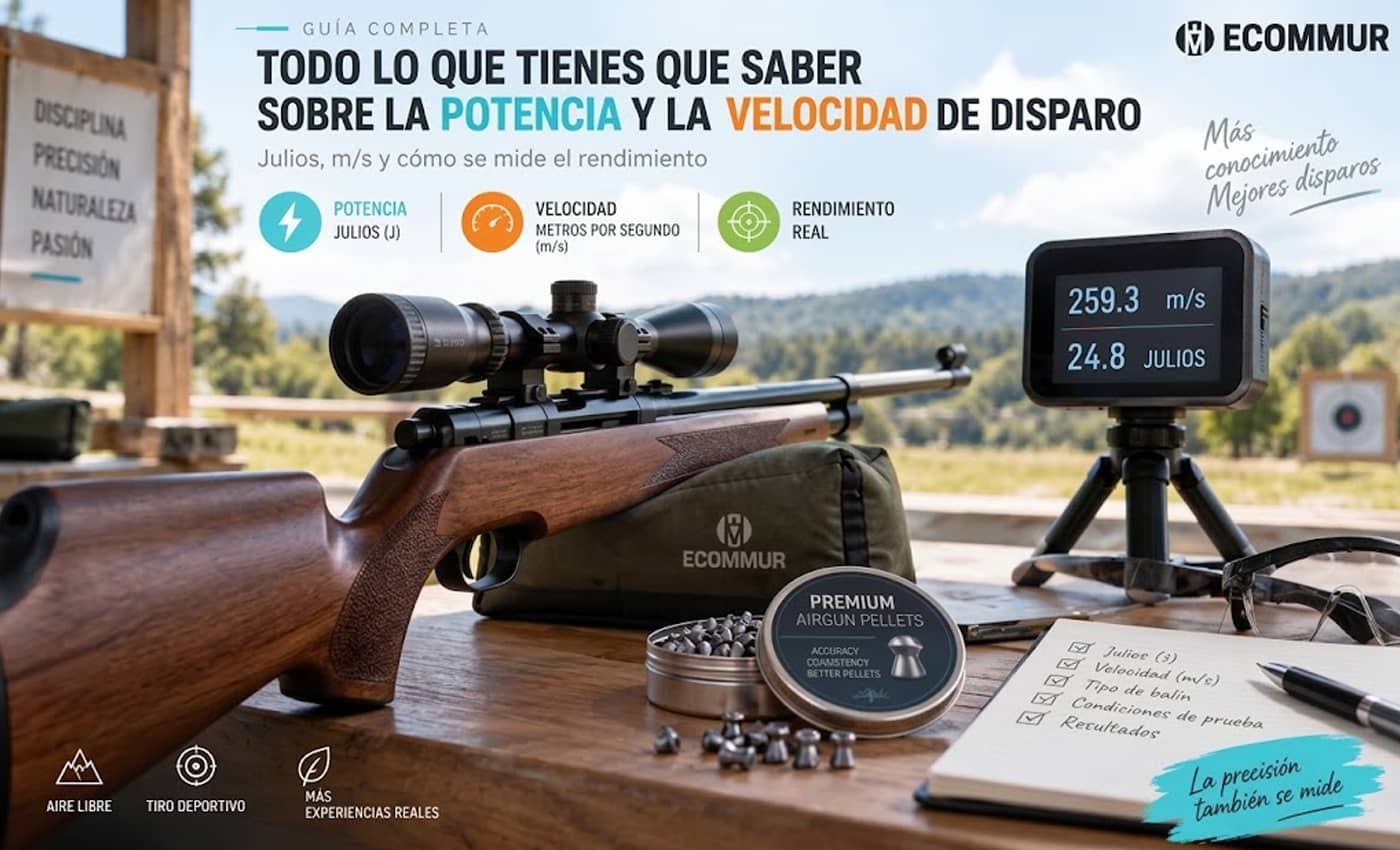
Power and velocity: two figures that may seem similar but mean different thingsThe muzzle velocity indicates how fast the projectile leaves the barrel. In Europe, it is normally expressed in metres per second, abbreviated as m/s. International specifications may also show FPS, meaning feet per second. Power is expressed in Joules. This figure indicates the kinetic energy carried by the projectile as it leaves the gun. Knowing the velocity alone is not enough to calculate it: you also need to know the weight of the ammunition. Therefore, when comparing two models, you should not focus only on figures such as 160 m/s or 240 m/s. Two guns can reach a similar velocity while producing different energy if they fire projectiles of different weights. | Quick guide m/s Projectile muzzle velocity. FPS Another unit of velocity: feet per second. Joules Projectile energy. It depends on velocity and weight. |
The formula for calculating Joules
Power is calculated by combining velocity and ammunition weight. Using velocity in metres per second and weight in grams, the practical formula is:
Joules = m/s × m/s × projectile weight / 2000
This formula explains why you should not judge an air rifle, pistol or replica solely by its advertised velocity. If the weight of the BB or pellet changes, the resulting energy can also change.
A high velocity does not always mean more power
Velocity is easy to compare: 120 m/s, 160 m/s, 240 m/s… However, this figure alone does not tell the whole story. In airsoft, a replica measured with 0.20 g BBs cannot be compared directly with another measured using 0.28 g BBs. The same applies to airguns when using light, medium or heavy pellets.
How muzzle velocity is measured
Velocity is not measured “by eye”. Specific devices called chronographs, also known as chronys or velocity meters, are used for this purpose. The projectile passes through a measuring area and the device calculates its speed, normally in m/s or FPS.
Many chronographs allow you to enter the weight of the ammunition. This means that, in addition to measuring velocity, they can calculate power directly in Joules. It is important to enter the correct weight of the BB or pellet used, as an incorrect weight will result in an incorrect Joule calculation.
How to take an accurate measurement
- Use compatible ammunition of a known weight.
- Position the chronograph correctly in line with the barrel.
- Measure close to the muzzle while keeping a safe distance from the device.
- Take several shots rather than relying on a single reading.
- Calculate an average of the readings obtained.
- Take factors such as temperature and the operating system into account.
Measurements that can be misleading
- Comparing velocities without knowing the ammunition weight.
- Using a single shot as the reference value.
- Comparing guns using BBs or pellets of different weights.
- Measuring CO2 or gas systems at very different temperatures.
- Entering the wrong ammunition weight into the chronograph.
- Treating a single measurement as an absolutely fixed value.
What factors affect actual power
Actual power does not depend solely on a figure shown in the technical specifications. The gun’s operating system, ammunition, internal sealing, temperature and test conditions can all influence the result. For this reason, even two units of the same model may show small differences in their readings.
| System | What can affect the reading | How to interpret it |
|---|---|---|
| CO2 | Temperature, condition of the capsule, rate of fire, valve and seals. | Performance usually drops in cold weather. Rapid successive shots can also cool the system. |
| Airsoft gas | Type of gas, temperature, magazine, valve, BB used and Hop-Up adjustment. | Not all gases behave in the same way. The same replica may produce different results depending on the weather and magazine. |
| Electric airsoft | Internal spring, air seal, nozzle, bucking, Hop-Up, battery and BB weight. | The battery mainly affects trigger response and rate of fire, while power depends primarily on compression and the spring. |
| Spring | Condition of the spring, seal, lubrication, pellet, break-in and internal adjustment. | Small variations may occur until the mechanism settles with use. |
| Gas piston | Condition of the piston, seal, ambient temperature, pellet and compression chamber. | It should also be measured using ammunition of a known weight to interpret the results correctly. |
| PCP | Reservoir pressure, regulator, valve, transfer port and pellet weight. | Velocity may vary depending on the pressure curve or regulation of the model. |
| Multi-pump | Number of pumps, sealing, valve, pumping technique and pellet weight. | More pumps generally increase pressure until the manufacturer’s designed limit is reached. |
Ammunition weight: the detail that changes JoulesIn airsoft, 0.20 g BBs are commonly used as a reference, although 0.25 g, 0.28 g and heavier weights are also widely used. The same applies to airguns: a light 4.5 mm pellet does not weigh the same as a heavier pellet, and it cannot be compared directly with a 5.5 mm pellet. As projectile weight increases, velocity normally decreases, but the relationship between velocity and energy depends on the system. This is why Joules are especially useful when you want to compare different measurements correctly. | “Joule creep” in airsoftSome replicas, especially gas, CO2 or HPA systems, may exhibit a phenomenon known as Joule creep: when heavier BBs are used, velocity decreases but the measured energy in Joules may increase. For this reason, when using a replica at an airsoft field, it is advisable to check both the Joules and the BB weight used and always comply with the limits set by the field. |
FPS, m/s and basic conversions
In Spain and Europe, m/s and Joules are commonly used. However, many manufacturers and international specifications use FPS. FPS means feet per second and measures exactly the same thing as m/s: velocity, not power.
Useful conversion: 1 FPS = 0.3048 m/s. And 1 m/s = 3.28084 FPS.
If you find a velocity given in FPS, you can easily convert it to m/s. However, to calculate Joules you will still need to know the weight of the ammunition used.
Power, regulations and usage limits: why it is important to tell them apart
In addition to knowing the power of an air rifle, pistol or replica, it is important to distinguish between the technical characteristics of the product, applicable regulations and the specific rules of the place where it will be used. Not all limits follow the same criteria and, particularly in airsoft, fields may establish their own playing and safety conditions.
| 01 | RegulationsRegulations may classify guns according to their characteristics, operating system and energy. Before using an airgun or airsoft replica, it is advisable to know which category it belongs to and the conditions that apply to its possession, transport and use. |
| 02 | Rules of useIn airsoft, fields often establish power limits depending on the role: pistol, rifleman, support, DMR or sniper. They may also require minimum safety distances and a chronograph test before the game begins. |
| 03 | Choosing the right modelMore power does not always mean that a model is better for you. Before choosing, it is worth considering the intended use, operating system, calibre, recommended ammunition, autonomy and any restrictions that may apply where you intend to use it. |
Common mistakes to avoid
- Comparing only m/s: without knowing the ammunition weight, the figure is incomplete.
- Confusing FPS with power: FPS measures velocity, not Joules.
- Measuring with one BB and using another: this can change velocity, trajectory and resulting energy.
- Using a single shot as a reference: it is better to take several readings and calculate an average.
- Ignoring temperature with CO2 and gas systems: it can significantly affect performance.
- Failing to check the limits of the place of use: fields and clubs may establish specific power limits and safety distances.
- Modifying power without the necessary knowledge: this can cause damage, malfunction or unsafe use.
Final points to avoid confusing the different concepts
| What are Joules? | They represent the kinetic energy of the projectile and are the most useful figure when talking about power. |
| What is m/s? | Metres per second. It indicates projectile muzzle velocity but does not represent power on its own. |
| What does a chronograph measure? | It measures projectile velocity. If the correct weight is entered, it can also calculate Joules. |
| Why can power change? | Because of factors such as ammunition weight, operating system, temperature, sealing, pressure, valves and test conditions. |
Conclusion
When comparing an air rifle, pistol or replica, do not focus only on the advertised velocity. m/s and FPS indicate velocity, while Joules indicate energy. To interpret a measurement correctly, you should also know the weight of the ammunition and take the operating system and test conditions into account. Understanding these figures will help you compare different models more accurately and choose the one that best suits your intended use.