





No products in the basket.


Spring-piston air rifle vs. piston air rifle: which one should I choose? Leave a comment
Practical guide to choosing better
Difference between spring and gas piston: which one should I choose?
If you are looking at an air rifle, sooner or later you will have this question: should I choose a spring or a gas piston? At first glance they may look very similar, but internally they do not work in the same way, they do not feel the same when shooting and they do not suit every user equally.
In this guide you will see the real difference between spring and gas piston, how each system works, what types exist, what cocking methods they can use, their advantages, their disadvantages, which is usually more comfortable, which produces less vibration and which may suit you better depending on your experience, budget and intended use.
The key before starting: what “piston” really means
There is a very common misunderstanding here. Technically speaking, many air rifles have an internal piston that compresses the air before the shot. However, when a shop or product description refers to a “piston air rifle”, it normally means an air rifle with a gas piston, also called gas ram, gas piston, IGT, Nitro Piston or similar names depending on the brand.
Therefore, when we compare spring vs piston, what we are actually comparing is:
- Traditional spring: uses a metal coil spring.
- Gas piston: uses a sealed cylinder containing pressurised gas.
What you should remember
In commercial terminology, “piston” almost always means gas piston, not simply “it has a piston inside”.
How each system works
Although they may look similar from the outside, their mechanical core is different. Here is the operating process explained in a simple way.
System 1
Traditional spring
- When cocking the gun, a metal spring is compressed.
- The spring is held in place by the trigger mechanism.
- When the trigger is pulled, the spring is released.
- The spring pushes the internal piston forward.
- The air is compressed inside the chamber.
- This compression propels the pellet through the barrel.
Typical feel: there is usually more vibration, more mechanical “bounce” and, on many models, a slight twisting effect or metallic sound.
System 2
Gas piston
- When cocking the gun, a sealed gas cylinder is compressed.
- The cylinder is held in place by the trigger mechanism.
- When the trigger is pulled, the system is released.
- The gas piston drives the internal piston forward.
- The air is compressed inside the chamber.
- This compression pushes the pellet through the barrel.
Typical feel: the shot usually feels sharper, more direct and with less “metallic” vibration, although this does not eliminate the recoil characteristic of airguns.
Quick diagram of the main components
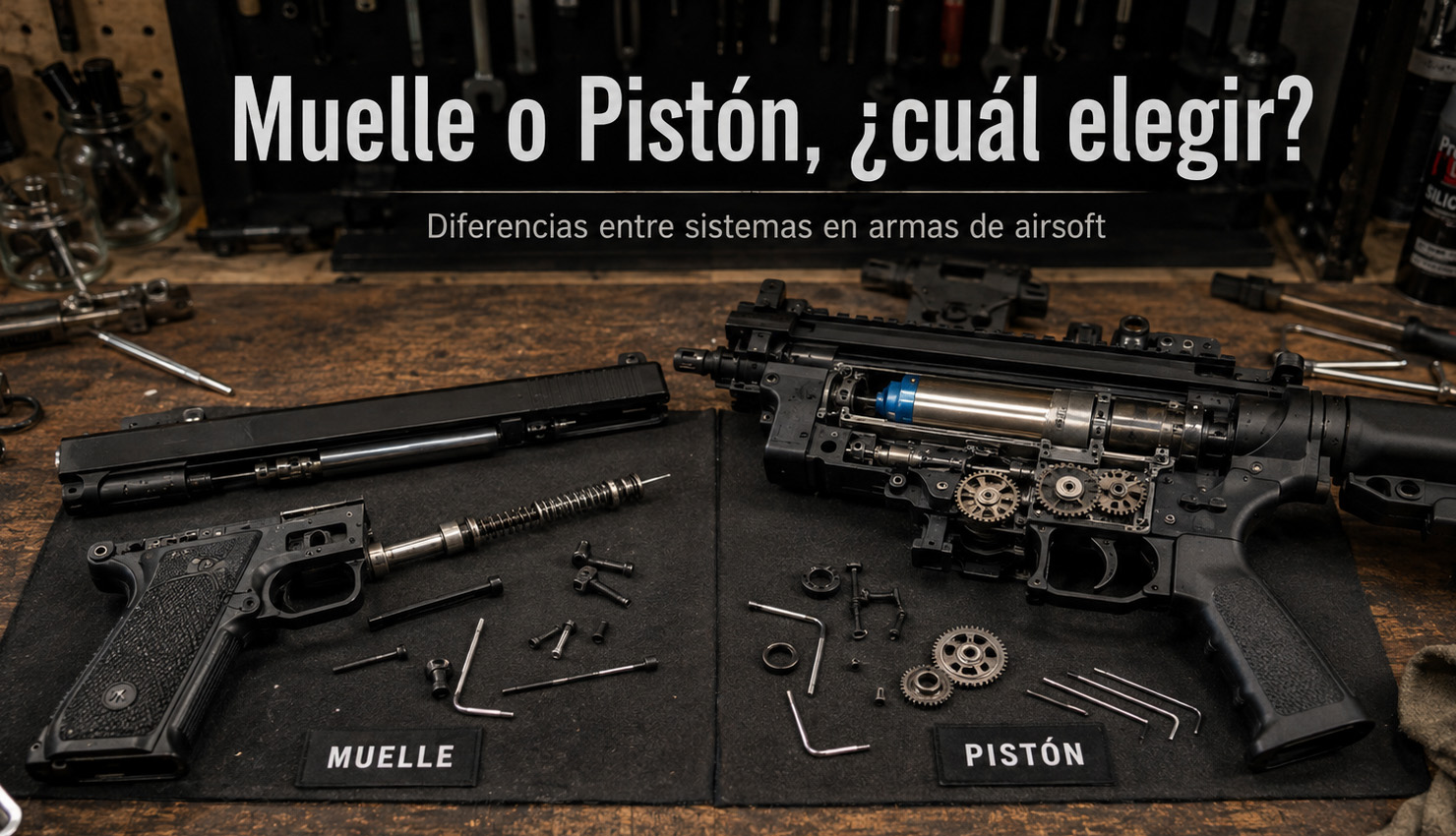
SpringBarrel → Compression chamber → Internal piston → Coil spring → Trigger → Stock / mechanism The distinguishing component here is the metal spring, which stores the mechanical energy for the shot. | Gas pistonBarrel → Compression chamber → Internal piston → Sealed gas cylinder → Trigger → Stock / mechanism The distinguishing component is the gas cylinder, which replaces the traditional spring. |
Types and cocking methods: something important that many people confuse
The power system and the cocking method are not exactly the same thing. An air rifle can use either a spring or gas piston while also being cocked in different ways.
Break barrel
This is the most common system. The barrel is “broken” downwards to cock and load the mechanism.
It can be found on both spring and gas piston models.
Underlever
The gun is cocked using a lever located beneath the barrel. Many users like this design because it keeps the barrel fixed.
It can also be found on spring rifles and, although less commonly, on some gas piston models.
Sidelever
The mechanism is cocked using a lever located on the side of the gun. This also allows the barrel to remain fixed.
It is more common in certain specific designs, especially classic spring models.
Important idea: how it is cocked and how it generates energy are two different things
Spring or gas piston describe the internal system that powers the shot. Break barrel, underlever or sidelever describe how the gun is cocked. Mixing up these two concepts causes a lot of unnecessary confusion.
Real comparison: spring vs gas piston
| Aspect | Spring | Gas piston |
|---|---|---|
| Operation | Uses a compressed metal coil spring. | Uses a compressed sealed gas cylinder. |
| Shooting feel | More vibration and sometimes more mechanical noise. | Sharper, more direct and normally with less metallic resonance. |
| Price | Usually more affordable. | Usually costs a little more. |
| Maintenance | Simple, well-known components and a replaceable spring. | Also simple in normal use, but the cylinder is usually replaced as a complete unit if it fails. |
| Durability | Very well proven; the spring can fatigue over time. | Can last a long time, but if it loses gas the unit must be replaced. |
| Leaving it cocked | It is not advisable to leave it cocked for too long. | It tolerates remaining cocked for somewhat longer, although this should not be abused either. |
| Cocking effort | Depends on the model; the effort can feel progressive. | Sometimes feels sharper or harder towards the end of the cocking stroke. |
| Accuracy | Can be very good if the gun is well made and good ammunition is used. | Can also be very good; the reduced vibration may help some users. |
| Scope compatibility | Requires a scope designed to withstand airgun recoil. | Also requires a scope designed for airguns. |
| Mechanical noise | Usually has more “twang” or internal resonance. | Usually sounds more compact and sharp. |
Advantages and disadvantages of each system
Advantages of spring
- Usually more affordable.
- Very well-known and proven technology.
- Spare parts and repairs are normally simpler.
- A good option for beginners without spending too much.
- There are a huge number of models available.
Disadvantages of spring
- Usually produces more vibration and metallic resonance.
- Can be more sensitive to the shooter’s hold technique.
- It is not advisable to leave it cocked for too long.
- The spring can fatigue over the years or with use.
- It can be harder on a scope if the optic is not designed for it.
Advantages of gas piston
- Usually offers a sharper and cleaner shooting feel.
- Normally produces less metallic vibration.
- Can better tolerate remaining cocked for somewhat longer.
- Many users feel that its behaviour is more modern.
- It can be more pleasant for frequent recreational shooting.
Disadvantages of gas piston
- Usually costs a little more than an equivalent spring model.
- If the cylinder fails, it is normally not “repaired” like a spring: it is replaced.
- On some models, the cocking effort can feel harder or sharper.
- It is not automatically more accurate than a spring model.
- It also requires proper technique and a suitable optic if a scope is fitted.
Which one is more powerful?
There is no absolute rule stating that gas piston is always more powerful or that spring is always weaker. Power depends on the specific design of the gun, the calibre, the internal setup and how the model is configured.
In other words: the system alone does not tell you the gun’s actual power. What does usually change is the shooting feel, vibration and mechanical behaviour.
Which one is more accurate?
Accuracy does not depend only on the system. The barrel, trigger, pellet quality, shot consistency, shooting technique and even the scope or sights being used all have a major influence.
That said, some users feel more comfortable with gas-piston air rifles because the vibration is usually somewhat more controlled. Others prefer the classic feel of a spring rifle and achieve excellent results. A good spring air rifle can group very well, just like a good gas-piston air rifle.
Practical conclusion: a gas piston may feel more pleasant for some users, but there is no “universal winner” in accuracy based solely on the system.
Which one should you choose for your needs?
This is where the question really becomes clearer. It is not so much about which one is “better”, but which one suits you best.
Choose spring if…
- You are looking for a more affordable option.
- You want something classic and proven.
- You value easy maintenance and spare parts availability.
- You like the traditional shooting feel.
- You want an air rifle for getting started without too much complication.
Choose gas piston if…
- You want a sharper shooting feel.
- The typical vibration of a spring bothers you.
- You prefer more modern behaviour.
- You are comfortable paying a little more for that feel.
- You want a recreational air rifle that is comfortable and pleasant to use.
If you are undecided between the two…
If your priority is price and simplicity, normally spring.
If your priority is shooting feel and less vibration, normally gas piston.
If you can try both systems, even better: how they feel in your hands will tell you much more than any product description.
Common mistakes when comparing spring and gas piston
- Thinking gas piston is always better: not necessarily; it depends on the user and the model.
- Believing spring is outdated and inferior: it remains an excellent and highly effective system.
- Confusing the power system with the cocking method: break barrel, underlever or sidelever are not the same as spring or gas piston.
- Choosing based only on power: vibration, comfort, technique, trigger and overall quality also matter.
- Fitting just any scope: both spring and gas-piston rifles require optics suitable for airguns.
- Believing a gas-piston rifle has no recoil: it does, although the sensation is different.
Frequently asked questions
Which is better for beginners, spring or gas piston?
If you want to spend less and get started with airguns using a very well-known system, spring is usually a good entry point. If you can invest a little more and prefer a sharper shooting feel with less vibration, a gas piston may be more pleasant.
Is a gas-piston air rifle more powerful than a spring rifle?
Not necessarily. The actual power depends on the specific model, calibre and design of the gun. The system affects its behaviour, but does not determine the total power by itself.
Which one vibrates more?
As a general rule, a spring usually produces more mechanical vibration and internal resonance. A gas piston usually provides a sharper and more compact shot.
Which one requires less maintenance?
Both systems are relatively simple in normal use. Spring mechanisms are very well known and are usually easier to repair or replace. With a gas piston, if the sealed unit fails, it is normally replaced as a complete unit.
Which one is more accurate?
There is no universal winner. A good spring air rifle can be very accurate, and so can a good gas-piston rifle. Many factors besides the system affect accuracy.
Can I leave a spring or gas-piston air rifle cocked?
It is not advisable to leave either type cocked for longer than necessary. Even so, a gas piston usually tolerates this better than a traditional spring.
What commercial names can a gas piston have?
Depending on the brand, it may appear as Gas Ram, Gas Piston, IGT, Nitro Piston, N-TEC and similar names.
Can both systems use a scope?
Yes, but the scope must be suitable for airguns. Both spring and gas-piston systems generate a particular movement that some scopes designed only for firearms or other uses do not tolerate well.
Conclusion: there is no perfect system, only the one that suits you better
If you want a more affordable, classic and easy-to-understand air rifle, spring remains a great option. If you are looking for a sharper shot, less metallic vibration and a slightly more modern feel, the gas piston is usually very appealing.
The best choice does not come from a simple slogan, but from considering your budget, preferred shooting feel, actual intended use, cocking method, the optic you plan to fit and your personal preferences. Once you understand that difference, you are much closer to making the right purchase.