



No products in the basket.


Scope Differences: Which One to Choose for Your Air Rifle? Leave a comment
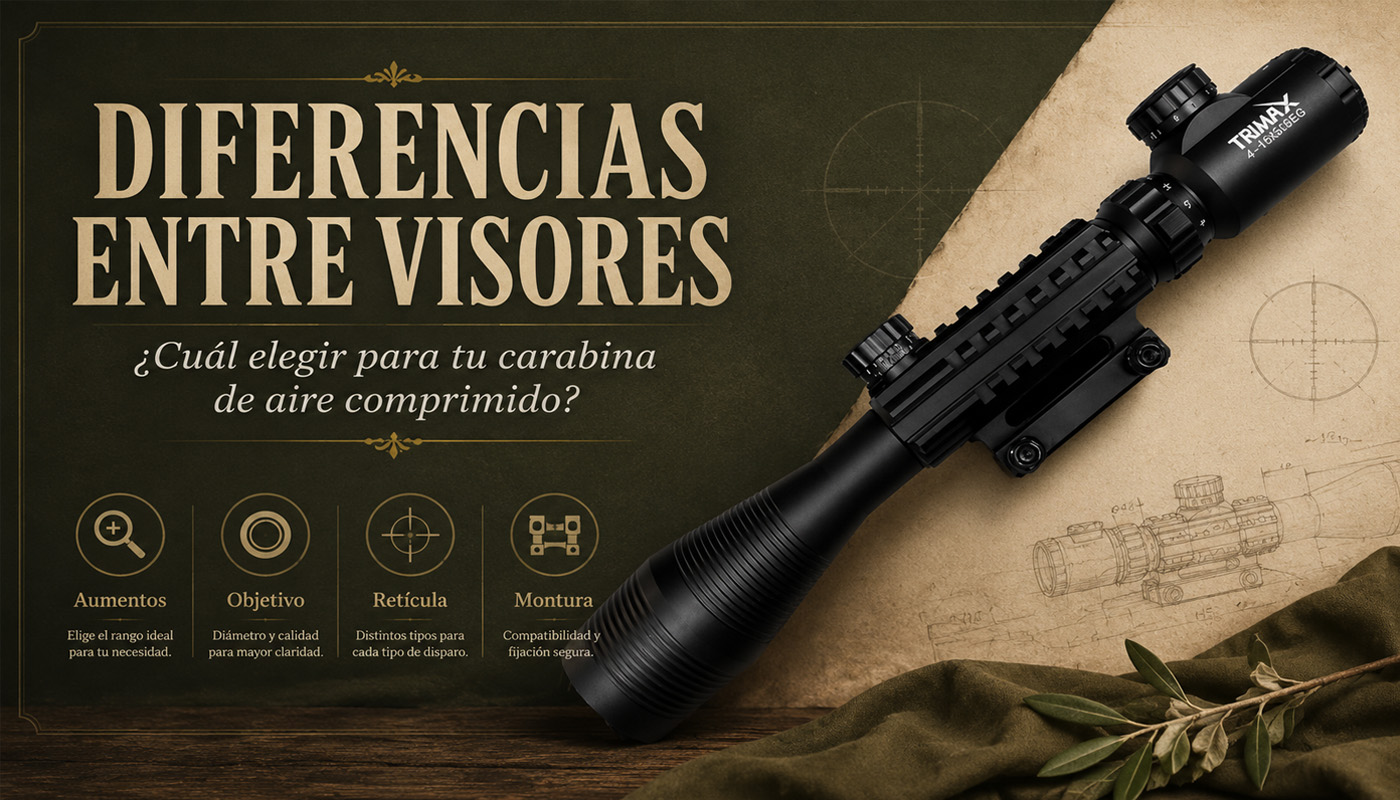
Differences between scopes: which one should you choose for your air rifle?
Choosing a scope for an air rifle can seem complicated at first: 4×20, 4×28, 4×32, 3-9×40, 4-16×50, illuminated reticle, 11 mm rail, 20 mm Picatinny, high mounts, low mounts, fixed magnification, variable magnification… and in the end comes the big question: which scope do I really need?
In this guide, we clearly explain the differences between the most common scopes, what the numbers on a telescopic sight mean, which scope to choose depending on distance, which mounts you need, how to know whether your air rifle has an 11 mm or 20 mm rail and how to keep your scope in good condition.
Quick scope guide
More magnification does not always mean a better scope
To choose the right telescopic sight, you need to focus on real use: shooting distance, type of air rifle, calibre, rail, mounts, scope weight, brightness and whether you need fixed or variable magnification.
🎯 For beginners
4×20, 4×28 and 4×32 scopes are simple, lightweight and easy to use. Perfect for recreational shooting at short or medium distances.
Ideal for: beginners and basic air rifles.
🔭 For more versatility
3-9×32 and 3-9×40 scopes allow you to adjust magnification depending on distance. They are among the best-selling options for air rifles.
Ideal for: general use and greater control.
⚙️ For advanced users
4-16×50, 6-24×50 or similar scopes offer more magnification, more adjustment and greater precision if the air rifle and distance allow it.
Ideal for: PCP, supported shooting and more precise shooting.
What the numbers on a scope mean: 4x20, 4x32 or 3-9x40
The numbers on a scope indicate two main things: magnification and the diameter of the front lens. For example, a 4×32 scope has fixed 4x magnification and a 32 mm objective lens. A 3-9×40 scope has variable magnification from 3x to 9x and a 40 mm objective lens.
Quick example: on a 3-9×40 scope, “3-9x” means you can zoom the image from 3 to 9 times, and “40” means the front lens measures 40 mm.
Quick comparison of the most common scopes
| Scope type | What it offers | Approximate distance | Recommended for |
|---|---|---|---|
| 4×20 | Very basic, lightweight and simple. | 10-20 metres. | Beginners, small air rifles and short-range recreational shooting. |
| 4×28 | Slightly more light intake than a 4×20. | 10-25 metres. | Users who want something simple but more comfortable. |
| 4×32 | Good fixed option, clear and easy to adjust. | 15-30 metres. | General-use air rifles. |
| 3-9×32 | Variable magnification in a compact size. | 15-40 metres. | Recreational shooting, lightweight air rifles and more versatility. |
| 3-9×40 | One of the most balanced scopes. | 20-50 metres. | Spring, gas piston and moderate PCP air rifles. |
| 4-16×40 / 4-16×50 | More magnification and better reading at distance. | 30-70 metres. | PCP, supported shooting and more demanding users. |
| 6-24×50 | High magnification and finer adjustments. | Medium/long distances with suitable equipment. | Advanced users, PCP and very controlled shooting. |
Fixed scope or variable scope: which one should you choose?
Fixed scopes: 4×20, 4×28, 4×32
A fixed scope always has the same magnification. They are simple, lightweight, easy to use and usually more affordable.
- Advantage: fewer complications.
- Advantage: good price.
- Advantage: ideal for beginners.
- Keep in mind: they do not allow you to zoom in or out.
Variable scopes: 3-9×40, 4-16×50, 6-24×50
A variable scope allows you to adjust magnification depending on distance, target and type of shooting. It is more versatile and complete.
- Advantage: more adaptable.
- Advantage: better for several distances.
- Advantage: more interesting for PCP.
- Keep in mind: it is usually larger and heavier.
Which scope to choose depending on distance
The distance of use is key. There is no point fitting a huge scope to shoot at 10 metres, just as a 4×20 may fall short if you are looking for more precision at greater distance. To choose well, first think about where and how you are going to use your air rifle.
Quick choice by distance
10-20 m: 4×20 or 4×28.
15-30 m: 4×32.
20-50 m: 3-9×32 or 3-9×40.
30 m or more: 4-16×40, 4-16×50 or higher, if the air rifle allows it.
Rails and mounts: 11 mm, 20 mm, Weaver and Picatinny
Before buying a telescopic sight, check the rail on your air rifle. You may have an 11 mm dovetail rail or a 20/21 mm Weaver or Picatinny rail. If the scope and the air rifle do not match, you will need compatible mounts or adapters.
🔩 11 mm rail
Very common on classic air rifles, spring air rifles, gas piston air rifles and many beginner models.
It requires mounts for 11 mm rails. If you install the wrong mount, the scope will not be properly secured.
⚙️ 20/21 mm rail
Very common on PCP air rifles, tactical models and modern accessories. It usually appears as Picatinny or Weaver.
It requires 20 mm mounts or mounts compatible with Picatinny/Weaver.
🔁 Adapters
If your scope, mounts or air rifle do not match, you may need an adapter from 11 mm to 20 mm or from 20 mm to 11 mm.
Before buying, carefully check rail size, tube diameter and mount height.
Tube diameter and mount height
In addition to the rail, you must also check the scope tube diameter. Many scopes use a 25.4 mm or 1-inch tube, while other larger models may use a 30 mm tube. The mounts must match that diameter.
Mount height is also important. A scope with a large lens, such as a 4-16×50 or 6-24×50, may need medium or high mounts so that the front bell does not touch the barrel, magazine or upper part of the air rifle.
Before buying mounts: check the air rifle rail, scope tube diameter and front lens size. These three details prevent most mistakes.
Prepared links for scope and mount categories
Here you can replace the # with your internal links to scope, mount and adapter categories.
| Category | When to link it |
|---|---|
| Air rifle scopes | To link to the main telescopic sight category. |
| 11 mm mounts | For air rifles with an 11 mm dovetail rail. |
| 20 mm mounts | For Picatinny or Weaver rails. |
| Rail adapters | To convert from 11 mm to 20 mm or from 20 mm to 11 mm. |
Reticle, illumination and parallax: details worth knowing
➕ Reticle
The reticle is the internal aiming pattern of the scope. It can be simple, crosshair-style, mil-dot or include reference marks. To start with, a clear and easy-to-see reticle is usually enough.
💡 Illuminated reticle
Some scopes include red, green or blue illumination. It can help against dark backgrounds or in low light, but it does not replace good optics or proper adjustment.
🎚️ Parallax
Parallax adjustment helps make the target clearer and reduce aiming errors at certain distances. It is especially useful in more advanced scopes.
Basic scope maintenance
A scope does not require complicated maintenance, but it does need some basic care to keep the image clear, avoid impacts and maintain adjustment for longer.
- Clean the lenses carefully: use a suitable microfibre cloth or lens cloth, never rough paper.
- Avoid impacts: a strong impact can knock the scope out of adjustment or damage the turrets.
- Protect the caps: use lens caps when you are not using it.
- Do not overtighten the mounts: you may mark the tube or stress the scope.
- Check screws: on air rifles with vibration, check that the mounts remain firm.
- Avoid prolonged humidity: store the scope and air rifle in a dry place.
Common mistakes when choosing a scope
- Buying too much magnification: more magnification is not always better if you shoot at short distances.
- Not checking the rail: 11 mm and 20 mm are not the same.
- Choosing the wrong mounts: they must match the rail and the scope tube.
- Not considering vibration: some spring or gas piston air rifles may require more resistant scopes.
- Mounting the scope too low: the front bell may touch the air rifle.
- Not setting the correct eye relief: poor positioning makes aiming uncomfortable.
- Not zeroing the scope: after mounting it, you need to adjust it so that the point of impact matches the point of aim.
Frequently asked questions about scopes and telescopic sights
Which scope should I choose for an air rifle?
For beginners, a 4×20, 4×28 or 4×32 may be enough. For more complete use, a 3-9×32 or 3-9×40 is usually a very balanced option. For PCP or supported shooting, higher-magnification scopes such as 4-16×50 or 6-24×50 may be interesting.
What does 4x32 mean on a scope?
It means that the scope has fixed 4x magnification and a 32 mm front lens. It is a simple, clear and easy-to-use scope for short and medium distances.
Which is better, 4x32 or 3-9x40?
The 4×32 is simpler and lighter. The 3-9×40 is more versatile because it allows you to adjust magnification. If you are looking for something basic, 4×32 may be enough. If you want more range of use, 3-9×40 is usually a better option.
Which rail does my air rifle have, 11 mm or 20 mm?
It depends on the model. Many classic air rifles use an 11 mm rail. Many PCP and tactical models use a 20/21 mm Picatinny or Weaver rail. Always check the technical specifications before buying mounts.
Can I fit a 20 mm scope on an 11 mm air rifle?
Only if you use compatible mounts or adapters. An 11 mm rail and a 20 mm rail are not the same, so the installation should not be forced.
Which mounts do I need for my scope?
You need to check three things: the air rifle rail, the scope tube diameter and the height needed so that the front lens does not touch the air rifle.
Is a scope with more magnification always better?
No. If you shoot at short distances, too much magnification can be uncomfortable. The important thing is to choose a balanced scope according to the distance, the air rifle and your type of use.
Which scope is best for a PCP?
For PCP air rifles, it usually makes sense to use more complete scopes, such as 3-9×40, 4-16×50 or similar, depending on the distance and the user’s level. It is also important to choose the right mounts and check the air rifle rail.
Conclusion: the best scope is the one that fits your distance, rail and air rifle
There is no perfect scope for everything. A 4×20 may be enough to start, a 4×32 can be a simple and effective option, a 3-9×40 is usually one of the most balanced choices, and a 4-16×50 or 6-24×50 may make sense on PCP air rifles, supported shooting or for users looking for more adjustment.
Before buying a telescopic sight, always check the distance of use, the air rifle rail, the type of mount, the tube diameter, the lens size, the scope resistance and whether you really need fixed or variable magnification.
Find the right scope for your air rifle
At Ecommur you can find scopes for air rifles, telescopic sights, 11 mm mounts, 20 mm mounts, rail adapters, scopes for PCP and accessories to better adjust your recreational shooting equipment.